
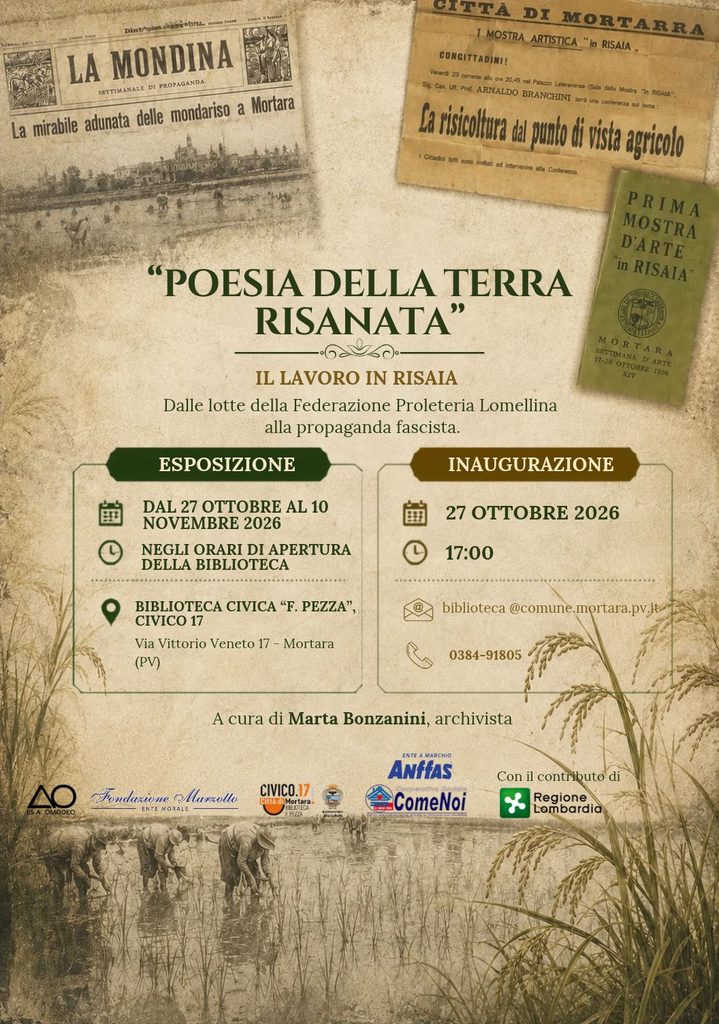
“Poesia della terra risanata”
Il lavoro in risaia
dalle lotte della Federazione Proletaria Lomellina alla propaganda fascista
“Nella primavera del 1920 in Lomellina si andava diffondendo ovunque un’atmosfera di paura e di terrore, favorita dallo sciopero dei contadini che durò quaranta giorni (…). Il lungo periodo di astensione dal lavoro non mi ha addolorato come quando un ordine contro natura veniva dato ai salariati: quello di abbandonare nelle stalle il bestiame. Quella notte ho avuto una sensazione precisa: una forza oscura unisce le reazioni nei campi diversi in lotta per portare la distruzione e la morte. (…) Lo sciopero che aveva provocato rancori e sparso odio nell’animo dei lavoratori e degli agrari si chiudeva formalmente alimentando con maggiore ferocia i tentativi delle squadre armate che scorrazzavano nelle diverse province, portando ovunque, con violenza, sistemi sconosciuti e gravidi di pericolo per la compagine nazionale”.
Paolo Moro, segretario della Federazione Proletaria Lomellina, in questa pagina di memorie, identifica con precisione i caratteri della diffusione del fascismo nel territorio: l’assuefazione alla violenza (grave lascito della Grande Guerra), la paura dei ceti medi nei confronti di una “rivoluzione rossa” in realtà più minacciata che reale, tentativi di pacificazione sociale che non scalfiscono odi e rancori tra salariati e proprietari terrieri, l’impunito “scorrazzare” delle bande squadriste che erodono il principio del monopolio statale della forza pubblica.
Nel volgere di pochi anni il fascismo sgretola le fondamenta dello Stato liberale svuotando dall’interno ogni sua struttura “attraverso una specie di rivoluzione legale”. Basti accennare all’accumularsi di leggi approvate nel 1926 volte allo smantellamento della rappresentanza democratica nelle amministrazioni locali con la soppressione dei sindaci, dei consigli comunali e delle giunte municipali, l’accentramento delle loro funzioni nella figura dei podestà, l’ampliamento del potere dei prefetti, l’eliminazione dei partiti d’opposizione, la soppressione della libertà di associazione e di sciopero, la nascita del Tribunale speciale e la fondazione dell’Ovra, la polizia segreta.
La demolizione dello Stato liberale avviene senza che alcuna seria opposizione venga prospettata da parte delle istituzioni tradizionali quali la monarchia: il regime si afferma nella convinzione (diffusa tra gli esponenti dell’antifascismo e radicata anche dopo il delitto Matteotti), che il movimento fascista, fautore di una pacificazione sociale, possa essere “normalizzato” e assorbito nel sistema liberale democratico. Si apre la via alla fondazione dello Stato totalitario.
ENGLISH
“Poetry of the Rehabilitated Land”
Labor in the Rice Fields: From the Struggles of the Lomellina Proletarian Federation to Fascist Propaganda
“In the spring of 1920 in Lomellina, an atmosphere of fear and terror was spreading everywhere, fueled by the farmworkers’ strike that lasted forty days (…). The long period of abstention from work did not grieve me as much as when an unnatural order was given to the wage laborers: to abandon the livestock in the stables. That night I had a precise feeling: a dark force unites the reactions in the various fields struggling to bring destruction and death. (…) The strike, which had provoked rancor and spread hatred in the minds of the workers and landowners, formally ended, fueling with greater ferocity the attempts of the armed squads roaming the various provinces, bringing everywhere, with violence, unknown systems pregnant with danger for the national fabric.”
Paolo Moro, secretary of the Lomellina Proletarian Federation, in this page of memoirs, precisely identifies the characteristics of the spread of fascism in the region: the habituation to violence (a serious legacy of the Great War), the middle classes’ fear of a “red revolution” that was actually more threatened than real, attempts at social pacification that did not scratch the hatreds and rancors between wage laborers and landowners, and the unpunished “roaming” of squadrist bands that eroded the principle of the state’s monopoly on public force.
Within a few years, fascism crumbled the foundations of the liberal State, hollowing out every structure from within “through a sort of legal revolution.” Suffice it to mention the accumulation of laws passed in 1926 aimed at dismantling democratic representation in local administrations with the suppression of mayors, municipal councils, and municipal juntas, the centralization of their functions in the figure of the podestà, the expansion of the prefects’ power, the elimination of opposition parties, the suppression of freedom of association and the right to strike, the creation of the Special Tribunal, and the founding of the OVRA, the secret police.
The demolition of the liberal State took place without any serious opposition being proposed by traditional institutions such as the monarchy: the regime established itself in the conviction (widespread among anti-fascist figures and rooted even after the Matteotti assassination) that the fascist movement, a proponent of social pacification, could be “normalized” and absorbed into the liberal-democratic system. The path to the foundation of the totalitarian State was thus opened.
FRANÇAIS
“Poésie de la terre assainie”
Le travail dans la rizière : des luttes de la Fédération prolétarienne de la Lomellina à la propagande fasciste
« Au printemps 1920, en Lomellina, une atmosphère de peur et de terreur se répandait partout, favorisée par la grève des ouvriers agricoles qui dura quarante jours (…). La longue période d’abstention du travail ne m’a pas autant affligé que lorsqu’un ordre contre nature fut donné aux salariés : celui d’abandonner le bétail dans les étables. Cette nuit-là, j’ai eu une sensation précise : une force obscure unit les réactions dans les différents camps en lutte pour apporter la destruction et la mort. (…) La grève, qui avait provoqué du rancœur et semé la haine dans l’esprit des travailleurs et des propriétaires terriens, s’achevait formellement tout en alimentant avec une plus grande férocité les tentatives des escadrons armés qui écumaient les différentes provinces, apportant partout, par la violence, des systèmes inconnus et lourds de péril pour l’édifice national. »
Paolo Moro, secrétaire de la Fédération prolétarienne de la Lomellina, identifie avec précision dans cette page de mémoires les caractères de la diffusion du fascisme sur le territoire : l’accoutumance à la violence (lourd héritage de la Grande Guerre), la peur des classes moyennes face à une « révolution rouge » en réalité plus menacée que réelle, les tentatives de pacification sociale qui n’ébranlent pas les haines et les rancœurs entre salariés et propriétaires terriens, et le « maraudage » impuni des bandes squadristes qui érodent le principe du monopole étatique de la force publique.
En l’espace de quelques années, le fascisme démantèle les fondations de l’État libéral en vidant de l’intérieur chacune de ses structures « à travers une sorte de révolution légale ». Il suffit de mentionner l’accumulation de lois adoptées en 1926 visant au démantèlement de la représentation démocratique dans les administrations locales avec la suppression des maires, des conseils communaux et des conseils municipaux, la centralisation de leurs fonctions dans la figure du podestà, l’élargissement du pouvoir des préfets, l’élimination des partis d’opposition, la suppression de la liberté d’association et du droit de grève, la création du Tribunal spécial et la fondation de l’OVRA, la police secrète.
La démolition de l’État libéral s’est produite sans qu’aucune opposition sérieuse ne soit proposée par les institutions traditionnelles telles que la monarchie : le régime s’est affirmé dans la conviction (répandue parmi les figures de l’antifascisme et enracinée même après l’assassinat de Matteotti) que le mouvement fasciste, partisan d’une pacification sociale, pouvait être « normalisé » et absorbé dans le système libéral-démocratique. La voie était ainsi ouverte à la fondation de l’État totalitaire.
ARABO
قصيدة الأرض المستصلحة
العمل في مزارع الأرز
من نضالات الاتحاد البروليتاري في لوميلينا
إلى الدعاية الفاشية
«في ربيع عام 1920 في لوميلينا، كان جو من الخوف والرعب ينتشر في كل مكان، يغذيه إضراب الفلاحين الذي استمر أربعين يومًا (…). لم يحزنني طول فترة الامتناع عن العمل بقدر ما أحزنني صدور أمر منافٍ للطبيعة للعمال المأجورين: وهو ترك الماشية في الحظائر. في تلك الليلة تولد لدي شعور دقيق: ثمة قوة مظلمة توحد الصراعات في المعسكرات المختلفة لتجلب الدمار والموت. (…) إن الإضراب الذي أثار الأحقاد وبث الكراهية في نفوس العمال والملاك الزراعيين انتهى رسمياً، ليغذي بشراسة أكبر محاولات الفرقة المسلحة التي كانت تجوب المقاطعات المختلفة، جالبة معها بالأنشطة والعنف أساليب مجهولة ومحملة بالمخاطر على النسيج الوطني».
باولو مورو، سكرتير الاتحاد البروليتاري في لوميلينا، يحدد بدقة في هذه الصفحة من مذكراته خصائص انتشار الفاشية في المنطقة: الاعتياد على العنف (وهو موروث ثقيل من الحرب العالمية الأولى)، وخوف الطبقات الوسطى من «الثورة الحمراء» التي كانت تهديداً أكثر منها واقعاً، ومحاولات التهدئة الاجتماعية التي لم تمس أحقاد وضغائن العمال المأجورين وملاك الأراضي، والإفلات من العقاب لـ «جولات» العصابات الفاشية (السكوادريستي) التي نالت من مبدأ احتكار الدولة للقوة العامة.
وفي غضون سنوات قليلة، فككت الفاشية أركان الدولة الليبرالية وأفرغت كل مؤسساتها من الداخل «من خلال نوع من الثورة القانونية». ويكفي الإشارة إلى تراكم القوانين الصادرة عام 1926 والتي هدفت إلى تفكيك التمثيل الديمقراطي في الإدارات المحلية من خلال إلغاء مناصب رؤساء البلديات والمجالس البلدية واللجان التنفيذية، وتجميع وظائفهم في شخص «البروديستا» (رئيس البلدية المعين)، وتوسيع سلطات المحافظين، وإلغاء أحزاب المعارضة، وحظر حرية تكوين الجمعيات والحق في الإضراب، وإنشاء المحكمة الخاصة وتأسيس الجهاز السرّي «أوفرا» (OVRA).
لقد تم تدمير الدولة الليبرالية دون أن تبدي المؤسسات التقليدية مثل المؤسسة الملكية أي معارضة جادة: لقد فرض النظام نفسه بناءً على قناعة (كانت سائدة بين رموز المناهضين للفاشية ومترسخة حتى بعد اغتيال ماتيوتي) مفادها أن الحركة الفاشية، الداعية إلى التهدئة الاجتماعية، يمكن «تطبيعها» واستيعابها داخل النظام الليبرالي الديمقراطي. وبذلك يفتح الطريق أمام تأسيس الدولة التوتاليتارية (الشمولية)
ELENCO DEI DOCUMENTI ESPOSTI
Censimento delle persone aventi titolo all assistenza, 25/6/1929
(Archivio Storico Comune di Mortara, ASCM, sezione novecentesca, b. 237)
Census of persons entitled to assistance, 25/6/1929
(Historical Archive of the Municipality of Mortara, ASCM, 20th-century section, b. 237)
Recensement des personnes ayant droit à l’assistance, 25/6/1929
(Archives Historiques de la Commune de Mortara, ASCM, section du XXe siècle, b. 237)
(237 قسم القرن العشرين، مجلد ،25/6/1929 (ASCM ،إحصاء الأشخاص المستحقين للمساعدة •
Lettera del presidente Onmi al podestà sul funzionamento del nido mondariso,26/4/1932
(ASCM, sezione novecentesca, b. 279)
Letter from the President of ONMI to the Podestà regarding the operation of the rice-weeder nursery, April 26, 1932
(Historical Archive of the Municipality of Mortara, ASCM, 20th-century section, b. 279)
Lettre du président de l’ONMI au podestat concernant le fonctionnement de la crèche pour les sarcleuses de rizières, le 26/4/1932
(Archives Historiques de la Commune de Mortara, ASCM, section du XXe siècle, b. 279)
قسم القرن العشرين، ،2391/4/62 (MSA ،إلى الحاكم المحلي حول عمل حضانة عاملات الأرز IMNO رسالة رئيس
(972 مجلد
Bollettino periodico Onmi, 25/3/1929
(Archivio Storico Comune di Mortara – ASCM, sezione novecentesca, b. 237)
Periodic ONMI bulletin, March 25, 1929
(Historical Archive of the Municipality of Mortara – ASCM, 20th-century section, b. 237)
Bulletin périodique de l’ONMI, le 25/3/1929
(Archives Historiques de la Commune de Mortara – ASCM, section du XXe siècle, b. 237)
(732 قسم القرن العشرين، مجلد ،INMO)، 25/3/1929 (MCSA) النشرة الدورية للعمل الوطني للأمومة والطفولة
Stagione risicola 1932: relazione sull assistenza all infanzia, 17/9/1932
(ASM, sezione novecentesca, b.279)
1932 rice-growing season: report on child assistance, September 17, 1932
(ASCM, 20th-century section, b. 279)
Saison rizicole 1932 : rapport sur l’assistance à l’enfance, le 17/9/1932
(ASCM, section du XXe siècle, b. 279)
(972 قسم القرن العشرين، مجلد ،2391/9/71 (MCSA ،موسم الأرز 2391: تقرير عن رعاية الطفولة
Lettera del presidente del Comitato di Patronato Onmi al presidente della Federazione Provinciale,
28/9/1929 (Fondo aggregato Asilo Nido, b. 1)
Letter from the President of the ONMI Patronage Committee to the President of the Provincial Federation,
September 28, 1929 (Aggregated Nursery School Fund, b. 1)
Lettre du président du Comité de patronage de l’ONMI au président de la Fédération provinciale,
le 28/9/1929 (Fonds agrégé Crèche, b. 1)
(1 إلى رئيس الاتحاد الإقليمي، 82/9/9291 (المجموعة الملحقة للحضانة، مجلد IMNO رسالة رنيس لجنة رعاية
Avviso Città di Mortara circa la Festa della Madre e del Fanciullo,
18/12/1933 (ASCM, sezione novecentesca, b. 295)
Notice from the City of Mortara regarding the Mother and Child Day,
December 18, 1933 (ASCM, 20th-century section, b. 295)
Avis de la Ville de Mortara concernant la Fête de la Mère et de l’Enfant,
le 18/12/1933 (ASCM, section du XXe siècle, b. 295)
(592 قسم القرن العشرين، مجلد ،3391/21/81 (MCSA ،إشعار من مدينة مورتارا حول عيد الأم والطفل
Opera Nazionale Balilla, circolare n. 35, 1929 – Corso informativo pratico teorico di educazione fisica,
27/6/1929 (ASCM, sezione novecentesca, b. 243)
Opera Nazionale Balilla, circular no. 35, 1929 – Practical and theoretical informative course on physical education,
June 27, 1929 (ASCM, 20th-century section, b. 243)
Opera Nazionale Balilla, circulaire n° 35, 1929 – Cours d’information pratique et théorique d’éducation physique,
le 27/6/1929 (ASCM, section du XXe siècle, b. 243)
،مؤسسة شباب إيطاليا (أوبرا نازيونالي باليلا)، منشور رقم 9291 ،53 – دورة إعلامية عملية ونظرية في التربية البدنية •(342 قسم القرن العشرين، مجلد ،9291/6/72 (MCSA
Affitto dell’azienda agraria Cordara e “Notizia sull’azienda”, 1929
(ASCM, sezione novecentesca, b. 234)
Lease of the Cordara farm and “Notice on the farm”, 1929
(Historical Archive of the Municipality of Mortara, ASCM, 20th-century section, b. 234)
Bail de l’exploitation agricole Cordara et « Note sur l’exploitation », 1929
(Archives Historiques de la Commune de Mortara, ASCM, section du XXe siècle, b. 234)
(432 قسم القرن العشرين، مجلد ،9291 (MCSA ،”استنجار المزرعة الزراعية كوردرا و”أخبار عن المزرعة •
(ASCM, Ministero dell’Educazione Nazionale, lettere al podestà, 13/10 e 12/6/1931, b. 271)
(ASCM, Ministry of National Education, letters to the podestà, 10/13 and 6/12/1931, b. 271)
(ASCM, Ministère de l’Éducation nationale, lettres au podestat, 13/10 et 12/6/1931, b. 271)
(172 قسم القرن العشرين، مجلد ،1391/6/21 (ASCM وزارة التربية الوطنية، رسائل إلى الحاكم المحلي، 31/01 و
A. Branchini, “Note pratiche di risicoltura”, Pavia, 1935 – Tenimento cascina Panza, orario di lavoro dei mondariso locali e forestieri, 1935 (ASCM, sezione novecentesca, b. 367)
A. Branchini, “Practical Notes on Rice Cultivation”, Pavia, 1935 – Panza Farm Estate, working hours of local and out-of-town rice weeders, 1935 (ASCM, 20th-century section, b. 367)
A. Branchini, « Notes pratiques de riziculture », Pavie, 1935 – Domaine de la ferme Panza, horaires de travail des sarcleuses de rizière locales et étrangères au pays, 1935 (ASCM, section du XXe siècle, b. 367)
(763 قسم القرن العشرين، مجلد ،5391 (MCSA ،قائمة عقود عاملات حقول الأرز الوافدات
Elenco numerico mondariso, 1927 (ASCM, sezione novecentesca, b. 228)
Numerical list of rice weeders, 1927 (ASCM, 20th-century section, b. 228)
Liste numérique des sarcleuses de rizière, 1927 (ASCM, section du XXe siècle, b. 228)
قسم القرن العشرين، مجلد ،7291 (MCSA ،الميليشيا التطوعية للأمن الوطني، تعليمات لرقابة حملة عاملات حقول الأرز 822)
Contratto di lavoro per la monda del riso alla tenuta Chiappona, 1930 (ASCM, sezione novecentesca,b256)
Employment contract for rice weeding at the Chiappona estate, 1930 (ASCM, 20th-century section, b. 256)
Contrat de travail pour le sarclage du rizière au domaine de la Chiappona, 1930 (ASCM, section du XXe siècle, b. 256)
(652 قسم القرن العشرين، مجلد ،0391 (MCSA ،عقد عمل لقطف الأرز في مزرعة كيابونا
Circolari prefettizie, 21 e 28 febbraio, 24 marzo 1927 (ASCM, sezione novecentesca, b. 228)
Prefectorial circulars, February 21 and 28, March 24, 1927 (ASCM, 20th-century section, b. 228)
Circulaires préfectorales, les 21 et 28 février, 24 mars 1927 (ASCM, section du XXe siècle, b. 228)
قسم القرن ،MCSA – منشورات المحافظة، 12 و 82 فبراير، 42 مارس 7291 (الارشيف التاريخي لبلدية مورتارا
Sindacato Fascista Agricoltori Lomellini, tariffe orarie, 1927 (ASCM, sezione novecentesca, b. 228)
Fascist Union of Lomellina Farmers, hourly rates, 1927 (ASCM, 20th-century section, b. 228)
Syndicat fasciste des agriculteurs de la Lomellina, tarifs horaires, 1927 (ASCM, section du XXe siècle, b. 228)
(822 قسم القرن العشرين، مجلد ،7291 ( MCSA ،النقابة الفاشية للمزار عين في لوميلينا، أسعار الاجور بالساعة
Questura di Pavia, ordinanza di servizio, 21/6/1934 (ASCM, sezione novecentesca, b. 234)
Police Headquarters of Pavia, service order, June 21, 1934 (ASCM, 20th-century section, b. 234)
Questure de Pavie, ordre de service, le 21/6/1934 (ASCM, section du XXe siècle, b. 234)
ص مكتوب على الآلة الكاتبة لخطاب ترحيب الحاكم المحلي جيوفاني اوموديو زوريني إلى اخيل ستاراتشي، سكرتير الحزب
(432 قسم القرن العشرين، مجلد ،4391 ( MCSA ،الوطني الفاشي
Lettera di ringraziamento al podestà della Confederazione dei Sindacati Fascista
dell’Agricoltura, 26/6/34 (ASCM, sezione novecentesca, b. 234)
Letter of thanks to the podestà from the Confederation of Fascist Agricultural Unions, June 26, 1934 (ASCM, 20th-century section, b. 234)
Lettre de remerciement au podestat de la Confédération des syndicats fascistes de l’agriculture, le 26/6/1934 (ASCM, section du XXe siècle, b. 234)
(432 قسم القرن العشرين، مجلد ،43/6/62 (MCSA ،رسالة شكر للحاكم المحلي من اتحاد النقابات الفاشية للزراعة
“La Mondina”, 30/6/34 (ASCM, sezione novecentesca, b. 333)
“La Mondina” [The Rice Weeder], June 30, 1934 (ASCM, 20th-century section, b. 333)
« La Mondina » [La Sarcleuse de rizière], le 30/6/1934 (ASCM, section du XXe siècle, b. 333)
(333 قسم القرن العشرين، مجلد ،43/6/03 (MCSA ،(لا موندينا” (عاملة حقول الأرز”
Invito a visitare la rassegna, 1/10/1936 – Pro memoria 2/10/1936 (ASCM, sezione novecentesca, b. 404)
Invitation to visit the exhibition, October 1, 1936 – Memorandum, October 2, 1936 (ASCM, 20th-century section, b. 404)
Invitation à visiter l’exposition, le 1/10/1936 – Aide-mémoire, le 2/10/1936 (ASCM, section du XXe siècle, b. 404)
(404 قسم القرن العشرين، مجلد ،639/10/12 (MCSA دعوة لزيارة المعرض، 1/01/6391 – مذكرة
Comunicazione di Carlo Accetti, organizzatore della mostra, 12/10/1936 (ASCM, sezione novecentesca, b. 404)
Communication from Carlo Accetti, exhibition organizer, October 12, 1936 (ASCM, 20th-century section, b. 404)
Communication de Carlo Accetti, organisateur de l’exposition, le 12/10/1936 (ASCM, section du XXe siècle, b. 404)
(404 قسم القرن العشرين، مجلد ،6391/01/21 (ASCM ،بلاغ من كارلو أسيتي، منظم المعرض
Lettera alla Prefettura circa l’acquisto di alcuni lavori esposti, 10/12/1936 (ASCM, sezione novecentesca, b. 404)
Letter to the Prefecture regarding the purchase of some exhibited works, December 10, 1936 (ASCM, 20th-century section, b. 404)
Lettre à la Préfecture concernant l’achat de certaines œuvres exposées, le 10/12/1936 (ASCM, section du XXe siècle, b. 404)
(404 قسم القرن العشرين، مجلد ،6391/21/01 (MCSA ،رسالة إلى المحافظة بشان شراء بعض الأعمال المعروضة
Riassunto manoscritto dei votanti al Plebiscito del 1929 – Circolare della Prefettura di Pavia, 8/3/1929 (ASCM, sezione
novecentesca, b. 242)
Manuscript summary of voters in the 1929 Plebiscite – Circular from the Prefecture of Pavia, March 8, 1929 (ASCM, 20th-
century section, b. 242)
Résumé manuscrit des votants au Plébiscite de 1929 – Circulaire de la Préfecture de Pavie, le 8/3/1929 (ASCM, section du
XXe siècle, b. 242)
قسم القرن ،9291/3/8 (MCSA ،ملخص مكتوب بخط اليد للمصوتين في استفتاء عام 9291 – منشور من محافظة بافيا •
(242 العشرين، مجلد
Milizia Volontaria per la Sicurezza Nazionale, lettera al podestà circa alcune “Iscrizioni sovversive”, 29/6/1929 (ASCM,
sezione novecentesca, b. 246)
Milice Volontaria per la Sicurezza Nazionale, letter to the podestà regarding some “subversive inscriptions”, June 29,
1929(Historical Archive of the Municipality of Mortara, ASCM, 20th-century section, b. 246)
Milice volontaire pour la sécurité nationale, lettre au podestat concernant certaines « inscriptions subversives », le
29/6/1929 (Archives Historiques de la Commune de Mortara, ASCM, section du XXe siècle, b. 246)
قسم ،9291/6/92 (MCSA ،”الميليشيا التطوعية للأمن الوطني، رسالة إلى الحاكم المحلي بشأن بعض “الكتابات التخريبية •(642 القرن العشرين، مجلد